We believe Jesus is the Son of God and the Messiah, the Christ.
We believe we are mystically united in the invisible One Body of Christ which cannot be divided.
We believe in the sacramental life and in the same seven sacraments even while the Orthodox acknowledge a few more
It is common for Orthodox Christians and Catholic Christians to marry each other. It is believed that in the marriage bond the two become one.
In education: Orthodox Christians in America often send their children to Catholic schools where the children also receive Catholic religious education during the week and then at their own parish on Sundays; many Orthodox Christians also choose to be educated in Catholic Universities.
Greek Orthodox Christians in America adapt Catholic Christian ministry templates to fit their own ministry needs because we are the closest theologically.
Some Roman Catholic Parishes are embracing the use of Iconography.
It is common for Orthodox Christians and Catholic Christians to pray together and worship our God together.
Curiously, the filioque clause, the Pope’s role in the administrative structure of the Church, and the other disagreements and divisions existing between Orthodox Christians and Roman Catholic Christians do not seem to prevent this oneness/unity.
Perhaps these and other examples are all reality because God is creating us to be the One Visible Church?
Imagine having access to a medicinal treatment known to heal what is broken into a united wholeness but before administering it insisting that everyone, patients included, agree about which doctor is supremely in charge of the medical field and how each doctor and medical group rank and order among each other.
It seems to me this is a similar approach to the full communion conversation between Orthodox and Catholic Christianity. People are expected to be healthy and whole somehow on their own before being allowed to receive medication together that is known to makes us healthy and whole.
While we can celebrate our agreements along with how fraternal friendships among East and West clergy of the highest ranks are the best in years, hinging full communion based on human will seems too fragile a foundation than what God has already done:
“…that they may be one as We are.” (John 17.11)
“…that they all may be one, as You, Father, are in Me, and I in You; that they also may be one in Us…” (John. 17.21, 22)
“…that they may be made perfect in one…” (John 17.23)
How much faster would full communion be realized if we shifted emphasis to our full communion with God?
God Himself changes hearts and minds as people spend time with Him and grow in loving relationship with Him when they commune with Him. If this happens on an individual basis and within a local community why not apply this to Orthodox and Catholic unity?
If East and West clergy and laity began receiving the medicine of immortality-the Eucharist- with the Christians with which we want to be in full communion, could God Himself change us and inspire us so we could more quickly resolve our complex, complicated organizational and theological differences?
It is my hope that Orthodox and Catholic Christians will soon be instructed by our Hierarchs to receive the Eucharist together trusting that our True Cornerstone God makes us perfect in one, in full communion, while we work through our differences.
In the Eastern Orthodox Christian tradition, there is a special service to celebrate three different Hierarchs on one day. Each of the three are celebrated on their own separate day and they also are celebrated together on one day. How did this happen?
Disputes and dissension erupted because people were arguing about which of the three men were the greatest. The three men appeared together in a dream to a Bishop showing him that they three are equal. They instructed the Bishop to write a service that would honor all three so as to quench the quarreling. On January 30th, each year this service continues to be celebrated as it has since around 1100 A.D.
Could it be that because God knew the Christian church would divide and split against His will for us that this feast of “The Three Hierarchs” as it has become known is also meant to guide our three major Christian experiences: Orthodox, Catholic, and Protestant to be honored as three separate individual groups; that we see ourselves as equal with the other two and that we three are to be celebrated as one?
Both Patriarch Bartholomew and Pope Francis have said that Christian Division is a scandal.
“It was precisely that Gospel truth that, at the beginning of the twentieth century, was the inspiration for the mobilization of our churches, who,confronted with the scandal of division, (emphasis mine) gave their attention to the pressing question of Christian unity, by establishing bonds of fellowship between divided churches and by building bridges to overcome their divisions.”[1]
“But we should recognize with sincerity and pain that our communities continue to live in division that is scandalous. Division among us Christians is a scandal. “(Emphasis mine)[2]
Obviously scandal is not virtue, it is sin. Thus, of all the reasons to proclaim oneness and unity in Christ immediately and then continue working through the issues that divide us, the scandal of schism requiring Christians to sin seems to be the most urgent.
Sin misses the mark. The mark is God Who is Trinity in Unity; Diversity in Unity; Three Persons in the Oneness of God.
In contrast, Christians are a trinity (Orthodox, Catholic and Protestant) divided; diversity in division; three in division.
Jesus prayed, “…that they may be one as We are.” Later Jesus prays that all who believe in Him may be one as the Trinity in Unity is One. (John 17.11; 20-23). Believe in Jesus and be one. Belief in Jesus Christ is all that He requires for oneness.
By 55 A.D. the Corinthian Christian community was divided and in factions. St. Paul wrote to them and we clearly see in 1 Cor. 1.10, 17-34 that he pleaded with them to work through their issues as one and commune together. What was St. Paul thinking? How could he counsel divided Christians to commune together? It is possible that he believed communing with the One, True God would heal their divisions and factions because God is divine medicine and perfect Oneness.
Even with God’s example and Paul’s guidance, over the centuries Church leaders and some Christians still choose the scandal of division for the collective church experience.
Therefore let us discover how this scandal of Christian division affects the individual Christian.
The definition of ancestral sin according to Orthodox Christianity, as I understand it, offers insights. Ancestral sin is theoretically defined like an inherited disease with ‘moderate to severe’ tendencies to sin personally but without being responsible for anyone else’s sins.
Practically, Christian schism requires the individual Christian to be responsible for the sins of those Church leaders who created and continue Christian division in the following ways. First, the individual Christian is responsible for the sin of a divided Christianity created by others just by being a member of a church. This inherited scandal is felt more acutely when the individual Christian disagrees and determines ours is a false division but has no authority to change the reality. (The phrase ‘false division’ refers to how churches have not followed Jesus’ own requirements for oneness nor St. Paul’s guidance to the Corinthians, as noted above.)
Second, the individual Christian must personally sin by maintaining and creating new Christian divisions in their own life. Take the example of upholding the created custom where baptized Christians are prevented from receiving God until that person first agrees with the community/denomination in which they are worshiping God. Once they join that church community by believing its theology and teachings then God is accessible to them.
The Gospels show a different process for receiving God.
Everyone who approaches Jesus Christ with faith that He is the Messiah and that He can help and heal them receive Him, often immediately, and without needing to agree with any community or even be baptized first. The focus is only on the person receiving God for their own salvation; the community that is God!
These few examples show how the scandal of Christian division requires Christians to sin both as a collective community and also as individuals. How might this acknowledged scandal finally propel us to proclaim our oneness and unity in the year 2024-2025?
After so many centuries officially divided, I imagine how it may feel irresponsible to pronounce our oneness and unity due to our outstanding differences.
Because this blog is a place to creatively imagine oneness and unity differently between East and West Christianity, the conclusion of the article is a possible pastoral message for how our spiritual shepherds could attend to the reality that Christian division requires Christians to sin.
Most honorable brother hierarchs and beloved children in the Lord,
Reminded of God’s vision for us that He makes us one as He is one, we the Fathers and Hierarchs of Christianity East and West acknowledge to you, our beloved spiritual children, that in our faithful work to dialogue and seriously study what divides us Christians we unintentionally lost sight of the impact schism has on you, the individual Christian. We now realize that our careful and slow approach to unity with each other actually makes you, our dear spiritual children sin by inheriting and maintaining this schism in your own lives and families. You personally bear the burdens of Christian schism; scandal that it is. We are deeply grieved and we humbly ask your forgiveness for this significant oversight.
So that you our cherished faithful Christian flock may be released from these sinful schism burdens we officially proclaim Christian oneness today because ultimately God has already done this for us through His Son’s ministry as the Chief Cornerstone.
You may be assured we will continue our dialogues and serious studies of the issues where we disagree in hopes of deeper understandings. Because we will all understand ourselves as one in Christ and will be communing together as St. Paul guides divided Christians to do (1 Cor. 1.10, 17-34) we expect to generate more quickly joint statements for our outstanding issues like for example, the role of the Pope of Rome/Patriarch of the West in the Christian experience.
We understand not everyone will agree with our newly realized oneness and unity however we ask for your patience and trust in God that He is inspiring and guiding us in this Way.
Please accept this starter plan for how we will live out our oneness in parish life.
Each Christian will be able to exercise their own free will and choose for themselves how to proceed. We expect every Christian community to continue practicing their beloved prayer and worship traditions. These will not be lost since we are not suggesting consolidating traditions into one. In this way we will imitate the Divine Diversity in Unity.
Then, for those Christians who agree with us, you will be responsible for finding the priest and community who also agree with our oneness/unity in God. That the Priest will be leading his community in our newly proclaimed oneness implies their Bishop agrees with us and is guiding their clergy in this way too. This will keep good order, as St. Paul says. (1 Corinthians 14.40)
In Church communities as described in the paragraph above, all baptized Christians may receive Christ sacramentally, practice their faith and then over time grow into communion and agreement with that church’s teachings, if they choose. Jesus Christ Himself taught us that the only requirement to be one is believing He is the Messiah; it is to our Lord’s requirement that we are returning.
Those Christians who are not ready to accept this oneness that God gifts us with will no longer be living in the sin of Christian schism because the Church will officially not be practicing it.
We know that this change may result in concerns from some that what we are describing is a ‘false unity’. We understand how you might be feeling as many of us have felt this way in our lifetime too.
What we are saying is that instead of making the focus of oneness about us-limited human beings that we are- we are saying now that we are one in the True God because He made us and makes us one. Again, we commit to you that we will continue working through our disagreements as we shared with you earlier in our caring counsel.
Because this approaches oneness and unity from a different direction, for those who are not ready to accept Christian oneness, you may continue with a Bishop, Priest and Community of your choosing and in the tradition of members’ only sacramental participation until such time as you personally and/or the community are ready to embrace East and West Christian oneness in Christ in the model introduced above.
It would even be expected that anxious attempts to divide from we who write these words and also from the communities who start to practice Christian oneness are contemplated and even begin to happen. While we will grieve such decisions please know those will be personal choices that will not affect the oneness God gifts to us as Christians of East and West. Our pastoral guidance to you will be the same as the Apostle Paul’s to his flock in Corinth. (1 Cor. 1.10, 17-34 ) Again, a path forward for you is described above. We do implore you to consider how we collectively missed throughout history how our division decisions actually goes against our Lord’s ministry for us. As spiritual shepherds we must lead our spiritual children to follow our Lord’s teachings and examples.
For now, we close believing we are continuing to be empowered by the Holy Spirit Who is guiding us to adjust our traditions for our uniquely modern era of the rejuvenated Body of Christ as expressed in Eastern and Western Christianity. We are confident we are following our ancient church’s creativity and innovations in tradition making with these words and actions.
Please continue to pray for us as we pray for you so that we may faithfully become more closely resembling our True God Who is One; a Diversity in Unity.
Paternally yours.
Creatively writing the proposed message in italics above is also a prayer that gives me brighter hope that our Christian oneness is truly right around the corner…stone.
As always, what is impossible with us, is possible with God…when we allow Him and follow Him!
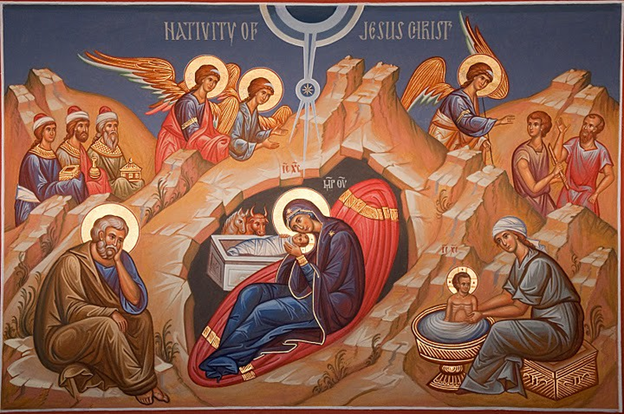
During the 2023 Christmas season, the local Christian radio stations played traditional and modern Christmas music. On Christmas day, the radio hosts spoke movingly about Jesus’ birth as the Messiah Incarnate. Their messages made Western Christianity seem to proclaim the very same beliefs about Jesus Christ born of the Virgin Mary as do Eastern Christians.
Inspired by the Lenten season, that season of changing one’s mindset and returning to God- sometimes even in a complete one hundred and eighty degree turn- Christian unity sounds simpler when returning to Jesus’ teaching about how His Church is being built together.
There is an applicable dialogue between Jesus and Peter which is written in three of the four Gospels. Here is a portion of it as it is written in the Gospel of Matthew 16.13-18.
“When Jesus came into the region of Caesarea Philippi, He asked His disciples, saying, “Who do men say that I, the Son of Man, am?” So they said, “Some say John the Baptist, some Elijah, and others Jeremiah or one of the prophets.” He said to them, “But who do you say that I am?” Simon Peter answered and said, “You are the Christ, the Son of the living God.” Jesus answered and said to him, “Blessed are you, Simon Bar-Jonah, for flesh and blood has not revealed this to you, but My Father who is in heaven. And I also say to you that you are Peter, and on this rock I will build My church…”
Jesus validates Peter’s faithful response with a pun filled proclamation, ‘…you are Peter (his name means rock in Aramaic and Greek) and on this rock (the rock solid revelation that Jesus is the Christ) is the foundation upon which Iwill build My (emphasis mine)church.’
Jesus says He is the one who builds people into this group He calls ‘church’ based on their own confession that He is the Christ (Messiah), the Son of the Living God.
Because Lent invites us to change our mindset to return to God, church leaders would change how they have been thinking about the criteria for unity. Doing so would make it possible to announce in our lifetime that Eastern and Western Christian unity has already happened by Jesus the Christ Who builds people into His church when they confess belief in His rock solid criteria as expressed above.
Such an announcement of unity may also acknowledge that the many and serious disagreements between Christians’ theologies and traditions will continue to be studied and possibly some of them even solved with God’s grace and guidance in our theological dialogues as we live and grow together as His one church.
*For an idea of what the three Christian Churches could exist like as one, please read “A Three in One Solution for Christian Unity” in this list of posts.





 Cornerstone Unites