Imagine having access to a medicinal treatment known to heal what is broken into a united wholeness but before administering it insisting that everyone, patients included, agree about which doctor is supremely in charge of the medical field and how each doctor and medical group rank and order among each other.
It seems to me this is a similar approach to the full communion conversation between Orthodox and Catholic Christianity. People are expected to be healthy and whole somehow on their own before being allowed to receive medication together that is known to makes us healthy and whole.
While we can celebrate our agreements along with how fraternal friendships among East and West clergy of the highest ranks are the best in years, hinging full communion based on human will seems too fragile a foundation than what God has already done:
“…that they may be one as We are.” (John 17.11)
“…that they all may be one, as You, Father, are in Me, and I in You; that they also may be one in Us…” (John. 17.21, 22)
“…that they may be made perfect in one…” (John 17.23)
How much faster would full communion be realized if we shifted emphasis to our full communion with God?
God Himself changes hearts and minds as people spend time with Him and grow in loving relationship with Him when they commune with Him. If this happens on an individual basis and within a local community why not apply this to Orthodox and Catholic unity?
If East and West clergy and laity began receiving the medicine of immortality-the Eucharist- with the Christians with which we want to be in full communion, could God Himself change us and inspire us so we could more quickly resolve our complex, complicated organizational and theological differences?
It is my hope that Orthodox and Catholic Christians will soon be instructed by our Hierarchs to receive the Eucharist together trusting that our True Cornerstone God makes us perfect in one, in full communion, while we work through our differences.
In the Eastern Orthodox Christian tradition, there is a special service to celebrate three different Hierarchs on one day. Each of the three are celebrated on their own separate day and they also are celebrated together on one day. How did this happen?
Disputes and dissension erupted because people were arguing about which of the three men were the greatest. The three men appeared together in a dream to a Bishop showing him that they three are equal. They instructed the Bishop to write a service that would honor all three so as to quench the quarreling. On January 30th, each year this service continues to be celebrated as it has since around 1100 A.D.
Could it be that because God knew the Christian church would divide and split against His will for us that this feast of “The Three Hierarchs” as it has become known is also meant to guide our three major Christian experiences: Orthodox, Catholic, and Protestant to be honored as three separate individual groups; that we see ourselves as equal with the other two and that we three are to be celebrated as one?
Disciple John is concerned because there was someone doing the works of Jesus Christ who was not exactly following them. John forbid him because, to use modern Christian terminology, he was not recognized by the disciples as in communion with them.
Jesus replies, “Do not forbid him, for no one who works a miracle in my name can soon afterward speak evil of me. For he who is not against us is on our side.”[1]
Eastern and Western Christians work miracles in Jesus’ name, do not speak evil of Him, and are not against Jesus and the disciples. According to Jesus’ definition, we Christians are already on His side altogether.
Our present unity is proven even more when certain Christians in both East and West are discovered many years after their physical death intact, that is, the body is not decomposing; they are incorrupt!
How can Christians living in division experience these same miracles if we disagree on so much?
Perhaps because we are communing from one Divine source whose very Being unites us!
Our reality is as if God is saying, ‘Look, I’m blessing you the same as each other while you continue to fight over who is more right.”
During the pandemic, some Christians stopped receiving the Eucharist. There was never any official pronouncement that those Christians should be excommunicated or that they were in error. Mercy and grace were offered by clergy leaders to members as they journeyed through this challenge. Members knew they could continue living their faith and return to receiving the Eucharist when they were ready.
Christians disagreed with other Church members on essential faith matters and were allowed to remain in communion.
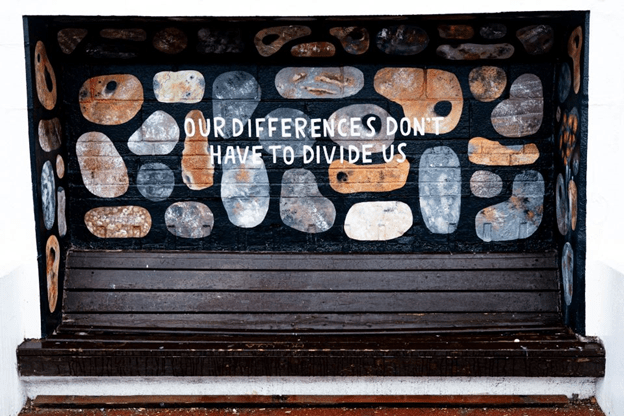
This article explores ideas for how the three Christian groups: Orthodox, Catholic and Protestant, who disagree on essential faith matters, could likewise be allowed with clergy leaders’ mercy and grace to consider ourselves in communion with each other.
The discussion around being in communion with each other is often focused on us and our efforts.
Replacing the words ‘Communion’ and ‘Eucharist’ with the words Jesus Christ says about Himself shifts the focus.
Jesus the Messiah describes Himself as the bread of life. He says, ‘whoever eats My flesh and drinks My blood has eternal life.’ (John 6.54) Later we learn what Jesus meant by His words when He took bread, blessed and broke it, giving it to his disciples saying “Take, eat; this is My body. Taking the cup, giving thanks and giving it to them he said “drink from it; this is My blood of the new covenant, shed for many for the remission of sins.” (Matthew 26.26-28).
Later in history, the Messiah’s body and blood became known as the ‘Eucharist’ and ‘Communion’. The word ‘Eucharist’ shares the same root word in Greek for a word that means ‘thanks’ highlighting how Jesus gave God the Father thanks at the Passover meal.
The word ‘Communion’ describes how receiving Jesus’ Body and Blood makes us become in union with God. It seems to me that these two words ‘Eucharist’ and ‘Communion’ helped Christians create the concept that by receiving the Eucharist people became in communion with each other and their understandings about God, too.
The words ‘Eucharist’ and ‘Communion’ will be replaced with the words Jesus says about Himself in select portions of an article by Bishop Kallistos Ware, of blessed memory, from the 1978 Journal of the fellowship of St. Alban and St. Sergius titled ‘Church and Eucharist, Communion and Intercommunion’.
Thus the title becomes, ‘The Body of Christ and Heavenly Bread, Body and Blood, and Bread of eternal life for whoever eats and drinks.’
‘The Church in its essence is the Body and Blood of the Messiah’ from ‘the Church in its essence is Eucharistic’. (551)
‘The Body and Blood of Christ holds the Church together as one’ instead of ‘the Eucharist holds the Church together as one’. (551)
‘As a Bread of eternal life organism or As a Body and Blood of the Messiah organism’ from ‘As a Eucharistic organism…” (552)
‘The Church maintains and realizes its unity in the Body and Blood of the Messiah’ from ‘…realizes its unity in the Eucharist.’ (552-553)
‘The Body and Blood of the Messiah creates the oneness of the Church’ from ‘It is the Eucharist that creates…” (553)
Jesus’ own words shift the focus to how He, the Messiah, unites people when they receive His body and blood. Jesus the Christ is doing the uniting and creating communion.
Christians may believe they are in communion with God when receiving the Eucharist but how can we be in communion with each other if our theologies and teachings are so different from each other?
Something similar seems to have happened in St. Paul’s ministry to the Corinthians. We read in the first letter to the Corinthians how St. Paul encouraged his faith community in Corinth that while they were divided and in factions they should keep working toward being one and at the same time continue receiving the body and blood of the Messiah together, carefully. Paul’s message is comparable to the sentence above, ‘the Body and Blood of Christ holds the Church together as one.’
Even if church leaders officially announced communion, what might happen to the existing three Christian groups: Orthodox, Catholic and Protestant once unity is proclaimed?
If we imitate the One, True God Who is three distinct Persons in One God could we acknowledge ourselves as three distinct Churches (Orthodox, Catholic and Protestant) in one Body of Christ?
A three in one model could mean that the Orthodox, Catholic and Protestant churches would remain exactly as they are today without consolidating. Especially in our modern day where individuality and niches are cultivated and honored, each church would describe themselves as three unique Christian journeys that have developed in the world over the centuries and are distinct options for whoever wants to become one with the True Triune God. Even if primacy was established, day to day church life in the three churches potentially could continue without much interruption, reordering or reorganizing.
Probably the most difficult adjustment would be regarding receiving the Body and Blood of Jesus Christ together since each of the three churches have very different practices, generally speaking.
The three distinct churches could retain their unique ways of preparing and distributing the Body and Blood of the Messiah. The existing ‘members’ only’ policy in many churches could be helpful for parishes and groups hesitant to immediately welcome all Christians to the Lord’s Table in their parish.
For the local parish eager to practice being in communion by receiving Jesus the Christ’s Body and Blood together, they might announce that only Christians baptized in the name of the Father, Son and Holy Spirit are invited to receive the body and blood of Jesus the Christ knowing that St. Paul strongly advises each person to examine themselves and determine if they are prepared to receive Him because doing so without preparation has been known to make people “weak and sick…and many sleep.”[2]
Concluding these creative thoughts with such a sobering warning is purposeful so that the reader knows how seriously the writer takes these topics along with the hopeful suggestions offered for accomplishing Christian unity, even in our lifetime.
It should also be stated clearly how it is well known that all of these ideas presented here could only become realities after the clergy leaders, scholars and theologians offer their collective blessing and guidance.
Here’s hoping for the eventual official pronouncement that Christ the Cornerstone has united us, is uniting us and will unite us in the communion of His Body and Blood while we continue working towards agreement on essential faith matters!



 Cornerstone Unites